The Genetically Engineered “Purple Tomato”™
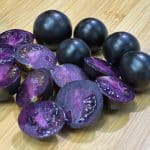 A genetically engineered (genetically modified or GM) tomato, trademarked The Purple Tomato™ was approved in Canada in August 2025. In January 2026, the company started selling small seed packets to home gardeners online and and the GM tomatoes are now on sale in some Loblaw grocery stores in Ontario and Nova Scotia(April 21, 2026).
Click here for our Consumer Alert, April 28, 2026
The seeds and fruit are not clearly labelled as genetically engineered.
What
This is a genetically engineered (genetically modified or GM) tomato with deep purple skin and flesh, now on sale in Canada.
The Purple Tomato™ (Del/Ros1-N) was genetically engineered with two genes from snapdragon flowers, to increase the plant’s anthocyanin production which also makes the tomato purple. Anthocyanins are a type of flavonoid that has antioxidant properties. They also give fruits and vegetables like blueberries, eggplants and some traditionally bred purple tomatoes their vibrant colours. There are already many non-GM purple tomatoes and many of these have increased anthocyanin levels (see below).
It has been approved for eating and growing in the US, Canada and Australia. A limited amount of the seeds and fruit have been on the market in the US since 2024.
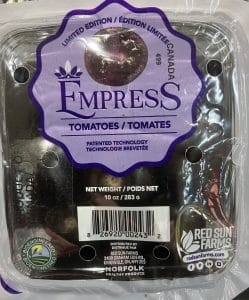 The commercial name of the GM tomato seeds and seedlings is The Purple Tomato™, and the name for the fruit sold in grocery stores is the Empress Limited Edition Tomato.
- This is the first GM tomato approved for growing in Canada.
- This GM purple tomato is the first GM tomato in Canadian produce sections.
- It is the first time that GM seeds are available and marketed to home gardeners.
The Flavr Savr™ Tomato (1995-1997): The only other genetically engineered tomato approved for eating in Canada (1995) was the Flavr Savr™ tomato for delayed ripening, from the company Calgene. It was grown and sold in the US but there is no record of it being for sale in Canada. It was taken off the market by the Monsanto soon after the company bought Calgene in 1997.
Where
In Canada, in April 2026, the GM tomatoes started to appear in produce sections in several Loblaw stores in Ontario and Nova Scotia – in Loblaws, Superstore and Zehrs. Click here to take action.
When
In April 2026, the GM tomatoes appeared in produce sections in Loblaw stores in Ontario and Nova Scotia (Altantic Superstore). Click here to take action.
The GM seeds were posted for sale online in early January 2026. They are in small packets of 10 seeds, marketed to home gardeners.
Health Canada and the Canadian Food Inspection Agency approved it for eating and growing in August 2025.
In the US, 2024 and 2025, the GM tomatoes were in a few grocery stores and at a few farmers’ markets. Red Sun Farms grew these tomatoes in the US in 2024 and can grow tomatoes all year round in large greenhouses to supply grocery stores.
Who
The small US company Norfolk Healthy Produce, based in Davis, California, was founded in 2021 to commercialize this GM tomato developed by Norfolk Plant Sciences, based in the UK. Norfolk Plant Sciences is a spinoff company of two research institutes in the UK (John Innes Centre and The Sainsbury Laboratory) and was established by Professors Cathie Martin and Jonathan Jones.
These GM tomatoes are sold by Loblaw Companies in Canada and are grown and distributed by Red Sun Farms, headquartered in Kingsville, Ontario. Red Sun Farms has large-scale greenhouse operations in Kingsville, Ontario as well as in the US (in Virginia) and Mexico. Red Sun Farms is Norfolk Healthy Produce’s large-scale “growing partner,” growing the Empress Limited Edition Tomato for grocery stores in the US.
How
This tomato is genetically engineered, meaning that changes were made directly to the genetic make-up of the tomato in the laboratory.
In this case, Agrobacterium was used to insert genetic material, including genes from snapdragon flowers. Three gene cassettes were inserted into the tomato variety MicroTom. The genetic material inserted includes:
- Genes from snapdragon flower (Antirrhinum majus) – Delila (Del) and Rosea1 (Ros1) genes (that encode transcription factors that regulate genes involved in anthocyanin biosynthesis);
- An antibiotic-resistant marker gene (the NPTII gene which confers resistance to the antibiotic kanamycin);
- Promoter (or promoters) to increase expression of the inserted genes.
The Del and Ros1 proteins have a regulatory role in the expression of anthocyanins in the tomato, i.e. they act like on/off switches. Their function in the tomato is to trigger the “on switch” for the tomato’s own endogenous anthocyanin biosynthetic pathway, resulting in an increase in the production of the anthocyanins in the tomato fruit.
Because this genetically engineered tomato has foreign DNA in it (DNA from another species), it triggers the Canadian novel food regulations and, unlike many future gene-edited vegetables, was assessed for food and environmental safety by Canadian regulators and is listed in Canada as an approved “novel food.”
See Butelli, E., Titta, L., Giorgio, M. et al. 2008. Enrichment of tomato fruit with health-promoting anthocyanins by expression of select transcription factors. Nature Biotechnology 26, 1301–1308.
Why
The company genetically engineered this tomato to produce anthocyanins.
This “Purple Tomato” is genetically engineered to have high levels of anthocyanins. However, in their safety assessment summary, Health Canada says that the anthocyanin levels in the GM tomatoes are in the same range of other foods, including other tomatoes:
“Anthocyanins are present in Purple Tomato in the range found in commonly consumed foods (e.g., blackberry, blueberry, cherry, red grapes, eggplant, etc.) including other varieties of tomatoes (3.00-588.86 mg/100 gfw). In addition, the predominant anthocyanins present in Purple Tomato (i.e., Delphinidin 3-O-(coumaroyl)rutinoside-5-O-glucoside and Petunidin 3-O-(coumaroyl)rutinoside-5-O-glucoside) are also present in commonly consumed foods.” [bolding added]
The scientists who genetically engineered “The Purple Tomato” also acknowledge that there are also effective antioxidant supplements already on the market.
Norfolk Plant Sciences wants to sell its first, and so far only, genetically engineered product.
Norfolk Plant Sciences set up the company Norfolk Health Produce (NHP) to sell The Purple Tomato. While NHP says “Our mission is to deliver nutritious, beautiful Purple Tomatoes to customers who embrace biotechnology for good and value our commitment to positive impact,” it does not prominently or clearly promote the tomato as a product of biotechnology. For example, that quote is from the last page of The Purple Tomato Cookbook and is the only reference to biotechnology/genetic engineering in the cookbook.
Companies want to commercialize new GM traits to promote consumer acceptance of GM foods.
All of the GM crops currently grown in Canada are herbicide-tolerant (and some are also insect-resistant) but companies want to be able to market new GM traits that are more attractive to consumers. For example, Bayer has invested in a program to genetically engineer “nutritionally enhanced vegetables”. Companies are promoting GMOs with new traits for “health and nutrition,” like The Purple Tomato™, or for improved taste, like Bayer’s GM gene-edited mustard greens that have been genetically engineered to taste less “mustardy,” and which Bayer wants to market as more nutritious than lettuce (see our No GMO Salad Update and Action Report for details).
Companies are actively testing the consumer market to launch GM fruits and vegetables.
Companies are launching some new genetically modified fruits and vegetables to find out how consumers will react, before they invest in even more GMOs. Until now, genetic engineering in our diets has been dominated by processed food ingredients from GM corn, GM canola, GM soy and GM sugar beet, but this could start to change. There are only three genetically modified fruits and vegetables currently on the market in Canada, with a very marginal presence in grocery stores: GM sweet corn, GM papaya, and GM pineapple (see our report Gene-Edited Fruits and Vegetables for details).
Companies want expand their market for GM seeds
When seeds are patented, the rights to save, breed and use or sell seeds are highly restricted. The rights to save seed are replaced with legal contracts that require farmers to purchase patented seed every season. It is not known how companies will enforce their intellectual property rights over GM garden seeds, however. For example, The Purple Tomato™ is patented but Norfolk Healthy Produce invites people to freely save the seeds from the GM fruit and replant and share them, as long as they do not sell the fruit, seeds or plants. The company says, “Growers can save the seeds and enjoy the plants and fruits in your home garden and with your local community.”
Non-GMO Purple Tomatoes
The genetically modified (GM or genetically engineered) “Purple Tomato” is not the only purple tomato on the market.
There are already many non-GM purple tomatoes and many of these have increased anthocyanin levels. There are over 50 varieties of non-GM purple tomatoes that have been bred using traditional methods (not genetic engineering) to contain anthocyanins. Anthocyanins are the flavonoid that give fruits and vegetables like blueberries and eggplants their vibrant colours.
Famously, the first traditionally-bred tomatoes that contain anthocyanins were bred by Dr. Jim Myers at Oregon State University, who, with his team, crossed wild tomato species with cultivated tomato varieties. Their first variety named Indigo Rose, released in 2011, led to the breeding of over 50 progenies (cultivars) with different variety names and unique traits. One such variety, bred in Canada, is the Lil Red N Black, bred by Vita Gaike and Duane Falk of Mimosa Breeding And Research near Hillsburgh, Ontario. There are other varieties with names such as Dancing with Smurfs.
In addition to a long list of non-GM tomatoes that contain anthocyanins (see below) there are a number of beloved heirloom varieties of purple-hued tomatoes, like Black Krim and Cherokee Purple, that get their purple hue from a pigment called pheophytin that does not contain anthocyanins.
Non-GM tomato varieties that contain anthocyanins |
GM tomato varieties that contain anthocyanins |
|
This is a list of some, but not all, of the varieties of non-GM tomatoes that contain anthocyanins. |
|
| Indigo Rose | The Purple Tomato™ “Althea” |
| Indigo Cherry Drops | The Purple Tomato™ “Dark Hollow” |
| Indigo Pear Drops | The Purple Tomato™ “The Eleven” |
| Indigo Kiwi | |
| Indigo Apple | |
| Midnight Roma | |
| Black Beauty | |
| Eye Candy | |
| Lucid Gem | |
| Blue Beauty | |
| Blue Gold | |
| Brad’s Atomic Grape | |
| Blue Berries | |
| Solar Vortex | |
| Showstopper | |
| Kryptonite | |
| Afternoon Delight | |
| Flavour Grenade | |
| Raspberry Burst | |
| Copper Olive | |
| Lil Red N Black | |
| Dancing with Smurfs |