Tomatoes
Market Status
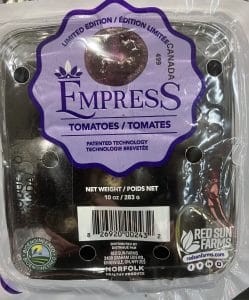 April 21, 2026: A genetically engineered (genetically modified or GM) tomato is now on the market in Canada. The genetically engineered Purple Tomato™ was approved for sale in Canada in August 2025 and is now sold in some Loblaws stores in Ontario and Nova Scotia (Atlantic Superstore). It is not clearly labelled as genetically engineered. GM purple tomato seeds in small packets can also now be purchased online by growers in Canada and the seedlings may appear in some garden centres.
The slow-ripening GM Flavr Savr™ was approved for eating in Canada in 1995 but taken off the market by Monsanto in 1997.
The Purple Tomato™ / Empress Tomato
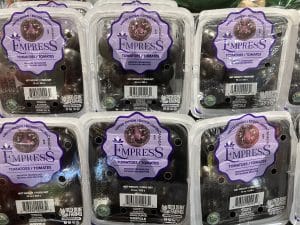 April 21, 2026: The genetically engineered “Empress” purple tomato is now on sale in Canada at some Loblaw stores. It was approved for growing and eating in Canada in August 2025. It is grown and distributed by Red Sun Farms, headquartered in Kingsville, Ontario. It is also sold as seeds for home gardeners and small growers as “The Purple Tomato” and could be sold as seedlings in some garden centres.
Ask Loblaws to remove genetically engineered fruits and vegetables from their stores. Click here to take action.
- Click here for our Consumer Alert, April 28, 2026
- Click here for more information on “The Purple Tomato”.
Unnecessary GM tomato: There are already many non-GM purple tomato varieties on the market that have been bred using traditional breeding methods to contain higher levels of anthocyanins. Click here for details and a list of non-GM purple tomatoes.
 Health claims: The company Norfolk Healthy Produce says the Purple Tomato™/Empress tomato was engineered for “health and nutrition.” It was genetically engineered with two genes from snapdragon flowers, to increase the plant’s anthocyanin production which is also makes the tomato purple. Anthocyanins are a type of flavonoid that has antioxidant properties. Many non-GM tomatoes already have increased anthocyanin levels, just like other purple vegetables such as eggplants. The packages of GE tomatoes now sold in Canada do not carry any health claim.
Patent enforcement: Norfolk Healthy Produce enforces patent protection over their GM seeds but tells gardeners that they may save and share the patented seeds as long as they do not sell them: “Growers can save the seeds and enjoy the plants and fruits in your home garden and with your local community.” Saving and sharing the seeds means that GM contamination will occur. There has already been confusion and controversy over this product when, in 2024, a well-known, non-GM heirloom seed company in the US sourced and advertised a purple tomato variety that may have been the GM tomato or was contaminated by it. Read more:
- GM purple tomato company targets non-GMO seed company over alleged patent infringement. GMWatch. March 12, 2024.
- Rotten tomato: Biotech company makes false claim about its GMO purple tomato. Ken Roseboro, The Organic and Non-GMO Report. April 9, 2024.
“We’re exploring it now and will likely be active next year on the Canadian front. What’s really important for us is to show in a market or test in a market, is this something that a lot of consumers really want?” – Nathan Pumplin, CEO, Norfolk Plant Sciences, US, 2023.
- CBAN Press Release – December 16, 2025: Farmers warn home gardeners about genetically engineered vegetable seeds coming soon
- CBAN Report – Updated December 2, 2025: Gene-Edited Fruits and Vegetables: The Threat of New GMOs in Canada
Other Updates
CBAN Report – Updated December 2, 2025: Gene-Edited Fruits and Vegetables: The Threat of New GMOs in Canada
October 2025 – GM Tomato Efficacy Test: A 21-day study on humans will be conducted to investigate if a gene-edited tomato (from the John Innes Centre, UK) can increase Vitamin D levels in humans. This is not a food safety study. Read more from GMWatch.
The Flavr Savr™ Tomato
1995-1997
The first GM food approved in Canada (and the US) was the “Flavr Savr” tomato from the company Calgene, which was later bought by Monsanto. It was genetically modified to soften at a slower rate, so that the tomato could stay ripening on the vine longer, before being picked for transport “resulting in more flavour.” (Tomatoes are generally picked unripe so they can survive transport to grocery stores and have a longer shelf-life).
The “Flavr Savr” was launched in the US in 1994 and approved in Canada in 1995, but was taken off the market by Monsanto in 1997.
Despite the disappearance of the “Flavr Savr,” the industry was still using it as an example to advertise the consumer benefits of genetic engineering three years later: An information kit circulated in 2000 in Canada, from the industry public relations group called the Council for Biotechnology Information (funded by Monsanto and other biotech nology companies) said, “Biotechnology is producing food that tastes better and stays fresh longer. Our new type of tomato ripens slowly, keeping it fresh for longer periods of time.”
Dr. Belinda Martineau, the former genetic engineer who developed the Calgene GM tomato, describes that they inadvertently inserted bacterial DNA into the Flavr Savr tomatoes and discovered the error before commercialization.
- Read about it in her article We need the whole truth to regulate GMOs, Biotech Salon, July 15, 2023.
- Read more in her book: Martineau, Belinda. First Fruit: The creation of the Flavr Savr™ tomato and the birth of biotech food. McGraw-Hill, 2001.