GM Animals
Market Status
There are no genetically modified (GM or genetically engineered) animals sold as food in Canada. The first, and so far only, GM food animal on the market was a GM Atlantic salmon sold in Canada 2017-2024 but production has been shut down.
Update – January 23, 2026: Health Canada has approved a gene-edited pig for human consumption but the meat from these genetically engineered (genetically modified or GM) animals will not be labelled for consumers. The GM animals are not yet on the market.
- CBAN Press Release – January 25, 2026: Group opposes Health Canada’s approval of gene-edited meat .
- Take Action: Click here to demand mandatory labelling.
CBAN Article – September 2025: Is There a Future for GE Animals? Watershed Sentinel.
On this page
GM Pigs
 Companies are asked to sign the pledge not to sell GM meat. Sign here: Company Commitment – No Hidden Genetically Modified Meat.
January 24, 2026: Health Canada has approved a gene-edited pig for human consumption but the meat from these genetically engineered (genetically modified or GM) animals will not be labelled for consumers. CBAN Press Release – January 25, 2026: Group opposes Health Canada’s approval of gene-edited meat .
The pigs are genetically engineered using the gene-editing technique of CRISPR, to make the animals resistant to the common PRRS virus (Porcine Reproductive and Respiratory Syndrome Virus). It was developed by the large global animal genetics company Genus and is being promoted by its subsidiary the “Pig Improvement Company” or PIC. The US Food and Drug Administration approved the gene-edited pig in April 2025 and Genus is also seeking approval in the export markets of Mexico and Japan. Click here for more information on the gene edited pig.
December 2020: The US Food and Drug Administration approved a gene-edited pig for use in both medicine and food. Revivicor’s “GalSafe” pigs were genetically engineered to eliminate the sugar alpha-gal, which can cause allergic reactions in some people and makes pig organs unsuitable for transplants. The company does not sell the pigs as food but reportedly provides meat on request.
Click here to demand mandatory labelling.
GM Enviropig™ Shut Down
In 2012, the project to commercialize the genetically modified (GM or genetically engineered) pig called “Enviropig” was shut down.
- June 22, 2012 – Press Release: GM “Enviropigs” Meet Dead End: Remaining GM pigs euthanized at the University of Guelph
- April 2, 2012 – Press Release: Genetically Modified Pig Shelved
In 2012, the hog industry group called Ontario Pork stopped funding the GM “Enviropig” research at the University of Guelph in Ontario. The university closed down its active research and ended its breeding program of the GM pigs. The GM pigs have been destroyed. The pig was engineered with genetic material from a mouse to reduce phosphorous in its feces. It could have become the first GM food animal approved in the world.Click here for more information on the “Enviropig”.
CBAN Report: Enviropig: Genetically Engineering Pigs to Support Industrial Hog Production, 2010.
GM Fish
 December 2024: The production of genetically modified Atlantic salmon has been shut down.
A genetically engineered (genetically modified or GM) Atlantic salmon was first sold in Canada In 2017, produced in Panama by the US company AquaBounty at an on-land pilot plant. Starting in 2021, the GM salmon was produced at on-land facilities in Prince Edward Island, Canada and Indiana, USA. Both of these facilities are now closed (2023/2024) and the company has announced the end of its fish farming and the sale of most of its assets. The company had claimed that the GM salmon grew faster – it was genetically engineered with a growth hormone gene from Chinook salmon and genetic material from ocean pout (an eel-like creature). Click here for details and background.
GM Insects
November 8, 2023 – Press Release: Expert Panel Commissioned by Health Canada Urges Caution on Gene-Edited Insects for Pest Control.
The Council of Canadian Academies (CCA) released an Expert Panel report commissioned by the Pesticide Management Regulatory Agency of Health Canada on the regulation of genetically engineering (genetically modified or GM) insects for pest control. The report focuses on the question of releasing gene-edited insects and “gene drive” organisms in particular, designed for release into the environment with the purpose of replacing or changing whole insect populations in the wild.
The Expert Panel concludes that the complexity and uncertainties of using such genetically engineered insects (genetically modified organisms or GMOs) raise profound questions and require serious attention from the federal government. CBAN, Vigilance OGM, Friends of the Earth Canada and Nature Canada are calling on the federal government to respond seriously to the Panel’s recommendations by recognizing the uncertainty and complexity that accompany proposals to release GMOs into the environment, including the need to engage the public and the expertise held in civil society. The groups are asking the government to ensure that no genetically engineered organisms are approved for release into the wild, for pest control or other purposes.
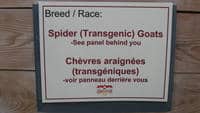
Breed/Race: “Spider (Transgenic) Goats”
GM Goats
In 2013, the Canada Agriculture Museum in Ottawa removed genetically engineered goats from display after public pressure.
Regulation in Canada
On October 4, 2016, CBAN testified at the House of Commons Agriculture Committee hearings on GM animals. Here is a summary of CBAN’s main recommendations to the Committee:
- There needs to be an assessment of economic impact before any GM product is approved for release
- There is a need to strengthen environmental risk assessment including a need to assess the long-term, system-wide risks of each GM product and the use of this technology as a whole
- Canada need systems for tracking and tracing all GM organisms
- Canadians need transparency in regulation
- Canadian consumers need mandatory labelling of all GM foods in the grocery store
We need to step back and ask:
- Is genetically engineering animals ethical?
- Is it acceptable to Canadians?
- Is it necessary?
There needs to be a moratorium on the introduction of GM animals until Canadians have a chance to be heard, and until changes are made to increase the government’s ability to regulate GM organisms and foods, including tracking and traceability, and transparency including mandatory GM food labelling.
The House of Commons Agriculture Committee study “Genetically modified animals for human consumption” made four recommendations:
- that the government provide greater transparency in the regulatory system that evaluates genetically modified animals intended for human consumption.
- that the government provide support for independent research into the health, environmental and other effects of new genetic modification technologies (including those to produce genetically modified animals).
- that the government support the mandatory labelling system only for issues of food health and safety.
- that the government work with industry to establish tools to provide traceability for genetically modified animals.